Fernando Alcoforado*
This article aims to demonstrate that the recent privatization of Eletrobras will be extremely harmful to Brazil because the national electricity system will operate to meet the profitability goals of its private shareholders to the detriment of electricity consumers and the interest of the Brazilian population. Brazil’s electrical system (Figure 1) involves a large infrastructure and a complex organization to make it work. It has the National Interconnected System (SIN), the National Electric System Operator (ONS), the National Electric Energy Agency (ANEEL) and Eletrobras.
Figure 1- Brazil’s electrical system

Source: https://journals.openedition.org/confins/10797
The National Interconnected System (SIN) is a large network that extends throughout Brazil, bringing together several generation plants and an electricity transmission grid that supply the country’s electricity demand with its subsystems Northeast, Southeast/Midwest, South and North. Most of the SIN is made up of hydroelectric plants, thermoelectric plants and, more recently, wind and photovoltaic solar plants. The last two types of plants are concentrated mainly in the Northeast region of the country. The existence of a network of almost 135,000 km that interconnects energy sources within the SIN brings several benefits, such, for example, as minimizing the risk of interruption in the electricity supply (generating safety) and greater efficiency of the electrical system, reducing generation costs with the economies of scale obtained.
The National Electric System Operator (ONS), which is an agency created in 1998, supervised and regulated by Aneel (National Electric Energy Agency), is responsible for coordinating and controlling the operations of the electricity generation and transmission facilities that are part of the SIN (National Interconnected System) in order to guarantee the safety and supply of electricity to the country. Isolated systems, that is, those not part of the interconnected electrical system, are also under its responsibility to integrate them into the operation. ANEEL’s main objective is to inspect and regulate the production, transmission, sale and distribution of electricity in the national territory. Another attribution of Aneel is to grant, authorize or permit electricity installations and services. In addition, ANEEL has the role of implementing policies in the sector, holding auctions and concessions, managing contracts, establishing rules for the energy service, creating a methodology for calculating tariffs, inspecting energy supply and mediating conflicts.
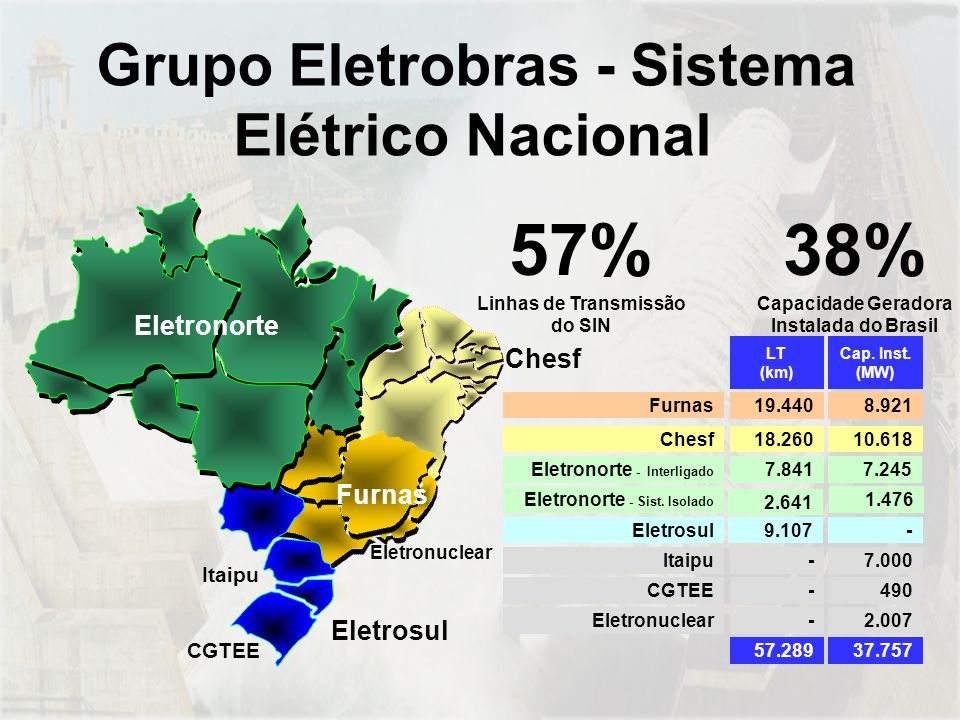
Eletrobras has a fundamental role in the National Interconnected System (SIN) because it has the attribution to promote studies, construction projects and operation of generating plants, transmission lines and substations destined to the supply of electric energy in the country. The studies and projects for the construction and operation of generating plants, transmission lines and substations are carried out based on the planning of the electric system in Brazil formulated by the Ministry of Mines and Energy through the Energy Research Company – EPE, whose purpose is to provide services in the area of studies and research aimed at subsidizing the planning of the energy sector, covering electricity, oil and natural gas and their derivatives and biofuels. The companies linked to Eletrobras are Eletrobras Amazonas GT, Eletrobras CGT Eletrosul, Eletrobras Chesf, Eletrobras Eletronorte, Eletrobras Eletronuclear, Eletrobras Furnas, Itaipu Binacional and Eletrobras Cepel. With these companies, the federal government owned 125 plants with a capacity of 50 gigagawatts of power (91% hydraulic), 71 thousand kilometers of transmission lines and 335 electricity substations. Hydroelectric plants such as Tucuruí, Belo Monte, Xingó, Sobradinho, Itaparica, Paulo Afonso and dozens of others, in full operation. It is an important company in the generation of electric energy in Brazil with 38% of the installed capacity and is a leader in electric energy transmission with 57% of the total transmission lines in the country in its basic network, in high and extra-high voltage
The Bolsonaro government recently managed to approve Provisional Measure 1031/2021 in the National Congress, which authorizes the privatization of Eletrobras and its subsidiary companies. Currently, the Brazilian State and the National Bank for Economic and Social Development (BNDES) hold 62% of Eletrobras’ shares. With the MP approved, this participation is now 45% with the right to a golden share, that is, the right to veto important decisions of the company. This privatization differs, therefore, from the conventional one in which the entire company is sold. The Bolsonaro government informs that the privatization will reduce the energy tariff by 7.36%. This is a fallacy because the privatization law will contribute to the privatized Eletrobras charging more for the energy produced by its plants. The consequence of the privatization of Eletrobras will be an average increase of 25% in the electricity bill for the consumer, according to Gilberto Cervinski and Fabiola Latino Antezana [See article Privatização da Eletrobras causará 25% de aumento na energia (Privatization of Eletrobras will cause a 25% increase in energy cost). Available on the website <https://www.redebrasilatual.com.br/blogs/blog-na-rede/2021/06/privatizacao-eletrobras-aumento-energia/>].
Figure 2 presents the Eletrobras system and its contribution to Brazil´s electric system.
Figure 2- Eletrobras System
Source: https://slideplayer.com.br/slide/1684691/
The privatization of Eletrobras will put an end to the current cheaper price of generating hydroelectric plants that currently sell their energy at the price of R$ 65/MWhh, while these privatized plants will charge above R$ 250/MWh for the same amount of hydraulic energy produced. This is because it will authorize the re-contracting of energy at the market price, in the so-called “Short-Term Market” (MCP), whose current value is above R$300/MWh. The net profit of the shareholders who buy Eletrobras will increase by 16 billion reais per year, at the expense of the 75 million Brazilian consumers with increases in the energy bill that will last for the next 30 years, the concession period provided for in the privatization process.
Gilberto Cervinski and Fabiola Latino Antezana above mentioned inform that in order to be able to approve the privatization of Eletrobras in Congress, the Bolsonaro government made numerous negotiations with deputies, senators and business groups in the electricity sector with negative impacts on tariffs due to their future increases. One of the negotiations was the obligation to contract 8,000 MW of highly polluting thermal power plants for 20 years to benefit private entrepreneurs, owners of thermal power plants powered by natural gas, sugarcane bagasse, eucalyptus residues, coal, etc., in addition to the law privatization obliges the energy distributors in each state to contract this energy as a “reserve.” In addition to this thermal energy being the most expensive in the country, they will be paid even with the plants turned off. It´s a tremendous absurdity this business. They have even established the mandatory reference price for hiring. This energy will cost R$367.92/MWh, according to a document from the Ministry of Mines and Energy, with a charge to be paid by consumers of R$18 billion/year in a 20-year contract.
Another deal was the contracting of 2,000 MW of Small Hydroelectric Plants that will benefit local entrepreneurs from each state that own these plants. The reference price will be R$315/MWh with a consumer charge of R$2.5 billion per year, which will be contracted for 30 years. This contract is absurd because Eletrobras sells hydraulic energy at R$ 65/MWh. In addition to all this, electricity consumers will have to pay an additional R$ 875 million per year over the next ten years to finance three regional projects from parliamentary benches in the Northeast, North and Southeast that has nothing to do with the electrical system. In the north, it is considered that part of the money could be used to subsidize navigation on the way from Porto Velho to the coast, for the transport of soy, wood, cattle and other export goods.
The privatization of Eletrobras will raise its costs by approximately R$40 billion in additional annual costs. Considering that the total national revenue of the electric sector from the captive consumer environment is R$ 160 billion per year (without taxes), and they will have to bear the readjustments, the resulting excessive tariff will tend to be approximately 25% in the electric energy bills , according to Gilberto Cervinski and Fabiola Latino Antezana cited above. The exorbitant increase in electricity tariffs will lead to greater de-industrialization in the country, an increase in company bankruptcy and higher unemployment. The privatization of Eletrobras will mean the privatization of water resources in the river basins of the hydroelectric plants, which will affect the interests of agricultural irrigators and, also, the commitment of the national energy planning that would no longer operate on a rational basis, serving the public interest because the country’s electric energy it will be completely dominated by private companies, especially foreign ones associated with Brazilian business groups, mostly banks and speculative funds that will buy Eletrobras.
For the above, the privatization of Eletrobras will produce, as a consequence, the exercise of control of the electricity system by private companies that will privilege its profitability over the interest of the Brazilian population as a whole and will burden electricity consumers with the increase of electricity tariffs to meet to the interests of private shareholders. A third and serious consequence is the risk of Eletrobras being controlled by foreign capital with serious consequences for national security because it would make the electric system vulnerable to external interference. These are three of the major consequences of the disastrous privatization of Eletrobras for Brazil. Add to the Eletrobras privatization disaster, the prospect of electricity rationing due to the scarcity of water in hydroelectric reservoirs that currently occurs. This fact will cause the use of thermoelectric power plants with higher operating costs, which will add to the costs resulting from the privatization of Eletrobras. Brazil will undoubtedly face energy shortages and extremely higher prices due to the use of thermoelectric power plants in addition to the costs of privatization burdening consumers. Blackouts may also occur, due to water scarcity in hydroelectric reservoirs.
From what has just been exposed, it has been demonstrated that the privatization of Eletrobras will be extremely harmful to Brazil because there is no operational or financial justification for its realization. The main justification that neoliberal governments like Bolsonaro’s offer for the privatization of state-owned companies is that they are inefficient and cause losses. On the contrary, in addition to being a company that provides relevant services to the country, contributing to national development, Eletrobras ended the year 2020 with a profit of R$6.4 billion, according to the financial statement. The Brazilian government expects to earn R$100 billion with the privatization of Eletrobras, which is an amount that could be obtained without its sale in 31 months with its share of the company’s profits. The privatization of Eletrobras will be even more damaging because the electricity system will start operating to meet the profitability goals of its private shareholders, to the detriment of electricity consumers and the interests of the Brazilian population. Therefore, there is no justification for the privatization of Eletrobras. It will be up to the future governments of Brazil to renationalise Eletrobras, which is a fundamental company for the country’s development.
* Fernando Alcoforado, 81, awarded the medal of Engineering Merit of the CONFEA / CREA System, member of the Bahia Academy of Education, engineer and doctor in Territorial Planning and Regional Development by the University of Barcelona, university professor and consultant in the areas of strategic planning, business planning, regional planning and planning of energy systems, is author of the books Globalização (Editora Nobel, São Paulo, 1997), De Collor a FHC- O Brasil e a Nova (Des)ordem Mundial (Editora Nobel, São Paulo, 1998), Um Projeto para o Brasil (Editora Nobel, São Paulo, 2000), Os condicionantes do desenvolvimento do Estado da Bahia (Tese de doutorado. Universidade de Barcelona,http://www.tesisenred.net/handle/10803/1944, 2003), Globalização e Desenvolvimento (Editora Nobel, São Paulo, 2006), Bahia- Desenvolvimento do Século XVI ao Século XX e Objetivos Estratégicos na Era Contemporânea (EGBA, Salvador, 2008), The Necessary Conditions of the Economic and Social Development- The Case of the State of Bahia (VDM Verlag Dr. Müller Aktiengesellschaft & Co. KG, Saarbrücken, Germany, 2010), Aquecimento Global e Catástrofe Planetária (Viena- Editora e Gráfica, Santa Cruz do Rio Pardo, São Paulo, 2010), Amazônia Sustentável- Para o progresso do Brasil e combate ao aquecimento global (Viena- Editora e Gráfica, Santa Cruz do Rio Pardo, São Paulo, 2011), Os Fatores Condicionantes do Desenvolvimento Econômico e Social (Editora CRV, Curitiba, 2012), Energia no Mundo e no Brasil- Energia e Mudança Climática Catastrófica no Século XXI (Editora CRV, Curitiba, 2015), As Grandes Revoluções Científicas, Econômicas e Sociais que Mudaram o Mundo (Editora CRV, Curitiba, 2016), A Invenção de um novo Brasil (Editora CRV, Curitiba, 2017), Esquerda x Direita e a sua convergência (Associação Baiana de Imprensa, Salvador, 2018, em co-autoria) and Como inventar o futuro para mudar o mundo (Editora CRV, Curitiba, 2019).

 Site Title