Fernando Alcoforado*
This article aims to demonstrate that the Keynesian economic policy adopted globally and the existence of a world government are the solutions to eliminate the chaos that characterizes the world economy today. John Maynard Keynes was the greatest exponent of neoclassical liberal economic thought linked to the Swedish Neoclassical School, which, with his works, promoted a revolution in economic doctrine, opposing, mainly, Marxist thought and classical liberal thought. His main work was The General Theory of Employment, Interest and Money launched in 1936. Keynes’ economic thought defends the State as an active agent against recession and high unemployment. By demanding a larger government as a decision maker in a country’s economy, Keynesianism positioned itself against classical liberal thought and other schools of neoclassical liberal thought that defend a state as small as possible. Keynes believed that capitalism could overcome its structural problems as an economic system as long as significant reforms were made, as he proposed, given that liberal capitalism, which dominated the world economy until 1945, had proved incompatible with maintaining full employment and economic stability.
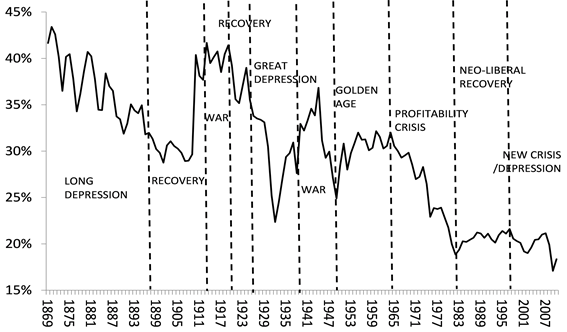
Keynes advocated moderate state intervention to achieve economic stability and ensure full employment in a country’s economy. Keynes stated that it is up to the State to encourage the increase in the means of production and the good remuneration of their holders. Keynesian thought left some trends that prevail to this day in the current economic system. Among the main ones, the use of macroeconomic models, moderate state interventionism and the use of mathematics in economic science. Neoclassical liberalism was successful with Keynesianism after World War II when it contributed decisively to the economic development of most countries in the world from 1945 to 1965 which is called the “golden age”. Figure 1 shows the world profit rate from 1869 to 2007.
Figure 1- Worldwide profit rate
Source: <https://contrapoder.net/artigo/a-taxa-e-a-massa-de-lucros/>.
In Figure 1, one can clearly see the vertiginous fall in the world rate of profit from 1965 to 1983, when there was a small recovery in the rate of profit after the adoption of the neoliberal model at the world level from 1983 to 1995. However, from 1995 to 2007, the drop in the world rate of profit points to the threat of a crisis that occurred in 2008 and a depression that did not evolve because governments acted to prevent the debacle of the world capitalist system.
Figure 2 shows the rate of profit in the United States, whose evolution from 1946 to 2012 is similar to that of the world rate of profit shown in Figure 1.
Figure 2- Profit rate in the United States
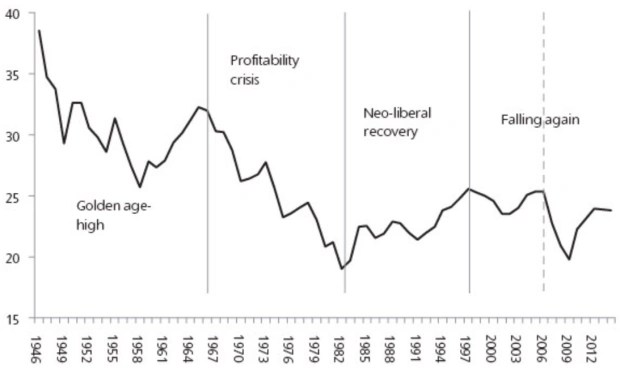
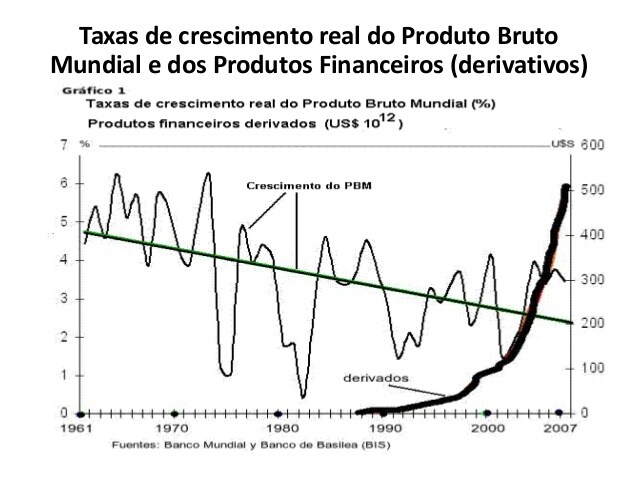
Figure 3 presents the real growth rate of the World Gross Product and Financial Products (derivatives). In it, we can see the drop in the growth of the Gross World Product from 1961 to 2007.
Figure 3- Real growth rates of the World Gross Product and Financial Products (derivatives)
Source: BEINSTEIN, Jorge. Rostos da crise: Reflexões sobre o colapso da civilização burguesa. Available on the website <http://resistir.info/crise/beinstein_04nov08_p.html>, 2008>.
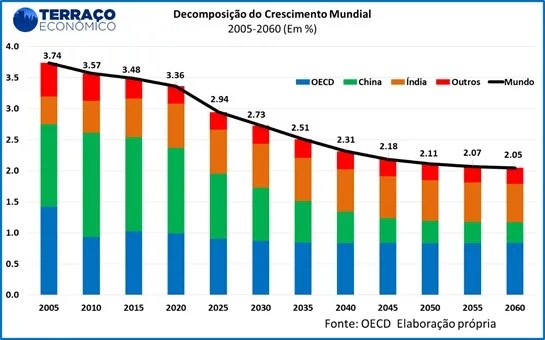
Figure 4 shows the declining global growth rate from 2005 with a projection to 2060.
Figure 4- World growth rate – 2005/2060
Keynesianism ceased to be effective in the 1970s with the drop in world economic growth after the so-called “glorious years” (1945/1965), because it was not able to solve the two oil crises and the debt crisis of most of the countries in the world that became insolvent with international banks. It is worth noting that in the “glorious years”, there were unparalleled rates of economic growth and generation of employment and income in the world economy and the combination of economic growth with fully employed labor, with reasonable wages and protected by the welfare social state being especially in Western European countries. Keynesianism was abandoned as the dominant economic thinking in the 1980s and replaced by neoliberal economic thinking that opposes Marxist economic thinking and Keynesian neoclassical social welfare liberal thinking and proposes the restoration of classical liberal economic thinking based on a vision conservative economic policy that aims to reduce the State’s participation in the economy as much as possible, not only at the national level, but also at the world level, whose expectation was to promote the resumption of the growth of the world rate of profit of the capitalist system.
However, neoliberalism that replaced Keynesianism also failed because the world profit rate and world economic growth continued to decline, not preventing the outbreak of the 2008 world crisis and chaos ensued in the world economy thanks to the absence of economic and global finance regulation. Faced with the failure of neoliberalism and its inability to deal with the global crisis of capitalism, Keynesianism could be the solution as long as it was applied globally, that is, it would operate in economic planning, not just at the national level to achieve economic stability and the full use of factors in each country, but also at a global level to eliminate the global economic chaos that currently prevails with neoliberalism. Keynesianism should also be adopted at the planetary level in order to ensure economic stability and full employment of factors globally.
With global Keynesianism, there would be the coordination of Keynesian economic policies at a planetary level that could only be carried out with the existence of a world government. This would be the way to obtain the stability of the world economy to eliminate the chaos that characterizes the neoliberal globalization currently dominant throughout the world. It is important to note that capitalism is a complex, dynamic, adaptive and non-linear system because it has elements or agents in large numbers that interact with each other, forming one or more structures that originate from the interactions between such agents. Complex systems are systems that are characterized by being dynamic whose fundamental characteristics are their sensitive dependence on the initial conditions by which, minimal differences at the beginning of any process, can lead to completely opposite situations over time. Chaos Theory explains the functioning of complex and dynamic systems. According to Chaos Theory, systems enter a state of chaos when fluctuations that were, until then, corrected by self-stabilizing feedbacks get out of control. The development trajectory becomes non-linear: prevailing trends collapse and in their place various complex developments arise. Chaos is rarely a prolonged condition. In most cases, it is just a transitional epoch between more stable states.
In order to manage a complex system such as capitalism, it is necessary to create feedback and control mechanisms by the world government to ensure the stability of the economic system. As capitalism is a dynamic system, “strange” or chaotic attractors can arise that can destabilize the system, even if there is “feedback” or government control. These “strange” attractors can be located in each country in the economic sphere, such as the drop in economic growth and inflation, in the political sphere, such as the existence of instability in the political system, as well as in the social sphere, such as example, unemployment and workers’ strikes. The “strange” or chaotic attractors can lead to the destabilization of a country’s capitalist system with global reflexes. With global Keynesianism adopted in the planning of the world economy and the existence of a world government, it would be possible to eliminate the chaos that generates uncertainty that characterizes the world economy subject to constant instabilities. The elimination of chaos or attenuation of instability and uncertainty with its turbulence and its risks in the world economy will only be achieved with the existence of a world government that would act to ensure the coordination between the Keynesian economic policies adopted in each country and globally. To be effective, the world government should adopt the Keynesian economic planning process that helps to eliminate instability and uncertainty with its turmoil and risks.
It should be noted that, from the point of view of global Keynesianism, the Gross World Product (GWP) can be calculated from the sum of all its components: GWP = C + I + G. In this formula, C (Global household consumption) corresponds to household expenditure in all countries on consumer goods (private consumption), I (Global private investment) corresponds to corporate expenditure in all countries in investment, either in capital goods (gross fixed capital formation) or in inventories of raw materials and products (inventories change), G (World government and country government consumption) corresponds to the expenditure of the world government and the governments of all countries on consumer goods. Globally, revenues from exports (X) and expenditures from imports (M) will not be computed because there would be no exchange between Earth and other planets. Based on this formula, the growth of the GWP can be obtained with the coordinated expansion with each country of the world of the global consumption of the families (C), the increase of the global private investment (I) and the increase of the expenditure of the Consumption of the world government and of the country governments (G).
The adoption of these measures with global Keynesianism requires the existence of a world government to coordinate the expansion of the economy in each country and globally. If in each country and/or globally there is a fall in global household consumption (C) and global private investment (I), it would be up to the world government and country governments to increase consumption by the world government and country governments (G ) to offset the fall in global household consumption (C) and global private investment (I) to maintain full employment and the stability of the global economy. This would be the feedback and control mechanism that made it possible to avoid crises of overproduction, recession and depression in the capitalist world economy.
Humanity will only move towards effective economic integration, initially, and politically, later, between countries as long as there is a world government and a globalized rule of law also works. There is a need for a democratic world government that can be realized with the restructuring of the UN, the transformation of the UN General Assembly into a world parliament and the transformation of the International Court in The Hague restructured into the World Supreme Court to make the international system work in benefit of all nations, promote the ordering of the world economy and the global environment, end wars and ensure world peace. International Law will only be respected and applied effectively with the existence of an international system that operates with a democratic world government, a world parliament and a World Supreme Court.
The ordering of society at the world level could be achieved with the constitution of a world government that would not only aim at the economic order and international relations at the world level, but, above all, create the conditions to face the challenges of humanity in the 21st century that could lead to its total collapse represented by the widespread and lasting disruption of the internet, the depletion of the global food supply system, a continental electromagnetic pulse that destroys all electronic devices, the collapse of globalization, the destruction of life on Earth by asteroids and by exotic particles coming from space, by global climate change, by the end of the global oil supply, by a global pandemic like the Coronavirus, by the collapse in the supply of electricity and drinking water, by intelligent robots that surpass humanity and by the collapse of world financial markets. Individual countries, even the most powerful, and current world institutions such as the UN, IMF, WTO, among others, do not meet the conditions to carry out these actions.
In order to make a world government viable, a World Forum for Peace and the Progress of Humanity must first be constituted by civil society organizations and governments from all countries in the world. In this Forum, the objectives and strategies of a world movement for the constitution of a government and a world parliament would be debated and established, aiming to sensitize the world population and national governments in the sense of making a world of peace and progress for all humanity a reality. This would be the path that would make it possible to transform the utopia of world government into reality. Without the constitution of a democratic world government, the scenario that unfolds for the future will be one of economic, political and social disorder and war of all against all.
* Fernando Alcoforado, 82, awarded the medal of Engineering Merit of the CONFEA / CREA System, member of the Bahia Academy of Education, engineer and doctor in Territorial Planning and Regional Development by the University of Barcelona, university professor and consultant in the areas of strategic planning, business planning, regional planning and planning of energy systems, is author of the books Globalização (Editora Nobel, São Paulo, 1997), De Collor a FHC- O Brasil e a Nova (Des)ordem Mundial (Editora Nobel, São Paulo, 1998), Um Projeto para o Brasil (Editora Nobel, São Paulo, 2000), Os condicionantes do desenvolvimento do Estado da Bahia (Tese de doutorado. Universidade de Barcelona,http://www.tesisenred.net/handle/10803/1944, 2003), Globalização e Desenvolvimento (Editora Nobel, São Paulo, 2006), Bahia- Desenvolvimento do Século XVI ao Século XX e Objetivos Estratégicos na Era Contemporânea (EGBA, Salvador, 2008), The Necessary Conditions of the Economic and Social Development- The Case of the State of Bahia (VDM Verlag Dr. Müller Aktiengesellschaft & Co. KG, Saarbrücken, Germany, 2010), Aquecimento Global e Catástrofe Planetária (Viena- Editora e Gráfica, Santa Cruz do Rio Pardo, São Paulo, 2010), Amazônia Sustentável- Para o progresso do Brasil e combate ao aquecimento global (Viena- Editora e Gráfica, Santa Cruz do Rio Pardo, São Paulo, 2011), Os Fatores Condicionantes do Desenvolvimento Econômico e Social (Editora CRV, Curitiba, 2012), Energia no Mundo e no Brasil- Energia e Mudança Climática Catastrófica no Século XXI (Editora CRV, Curitiba, 2015), As Grandes Revoluções Científicas, Econômicas e Sociais que Mudaram o Mundo (Editora CRV, Curitiba, 2016), A Invenção de um novo Brasil (Editora CRV, Curitiba, 2017), Esquerda x Direita e a sua convergência (Associação Baiana de Imprensa, Salvador, 2018), Como inventar o futuro para mudar o mundo (Editora CRV, Curitiba, 2019) and A humanidade ameaçada e as estratégias para sua sobrevivência (Editora Dialética, São Paulo, 2021) .

 Site Title