Fernando Alcoforado*
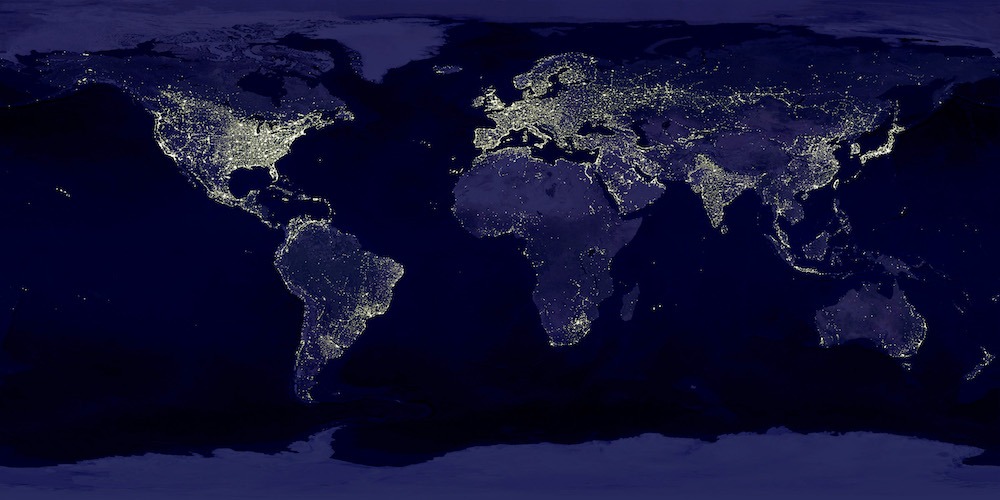
The lights of planet Earth seen from space by artificial satellites bring a lot of information about progress, development and economic delay depending on their intensities in each region of the terrestrial globe. The brightest lights in Western Europe, the United States, Canada and Japan indicate that they are the richest regions, with the greatest progress and development. These are the regions where the most economically developed central capitalist countries are located.
Intermediate intensity lights of planet Earth seen from space by artificial satellites in Eastern Europe, India, China, Mexico, Cuba, Colombia, Venezuela, Chile, on the eastern coast of the South Atlantic from Argentina to the extreme northeast of Brazil, in the Pretoria region of South Africa, in South Korea, in Singapore, on the east coast of Australia and New Zealand report that they are regions of intermediate economic development where the semi-peripheral capitalist countries are located.
The regions devoid of lights of planet Earth seen from space by artificial satellites are the most backward regions of planet Earth, as is the case of most of South America, almost all of Africa, part of Eastern Europe, most of Asia and Australia inform that they are the regions of low economic development where the peripheral capitalist countries are located.
The lights of planet Earth seen from space by artificial satellites are more intense in the regions of the central capitalist countries because they accumulated wealth with the exploitation of peripheral and semi-peripheral countries since the 16th century and were pioneers in scientific and technological development from the Renaissance and Scientific Revolution in Europe and in the industrialization process with the realization of the 1st, 2nd, 3rd and 4th Industrial Revolution. All this contributed to the exponential increase in agricultural, industrial, trade and services production and to the development of a gigantic energy, transport, communications, housing and sanitation infrastructure, in addition to the development of magnificent education systems and health.
The lights of planet Earth seen from space by artificial satellites of intermediate intensity in the semi peripheral countries resulted from investments from the central capitalist countries and from initiatives by the governments of these countries to promote late development. They report that the developmental effort has been insufficient because these countries are dependent on foreign capital that obtains extremely high profits in them and inhibits the development of the productive forces internally to maintain domination by the central capitalist countries. Unlike central capitalist countries, semi-peripheral countries have deficiencies in their productive capacities, in their infrastructure, and in their education and health systems due to insufficient resources for investment and the inability of local governments to promote economic development.
The low intensity lights of planet Earth seen from space by artificial satellites in the regions of the peripheral countries resulted from the lack of interest of investors from the central capitalist countries to invest in them and the lack of initiative and capacity of local governments to promote economic development. There are very few regions in peripheral countries where foreign investments were made and where local government initiatives to promote economic development took place. This explains the low development achieved by them.
In order to make the brightest lights shine even in the peripheral and semi-peripheral regions of the planet, it is necessary that the governments of the member countries unite in the effort to promote a rupture with the external dependence of capital, making an effort of cooperation with each other aiming the economic development of all peripheral and semi-peripheral countries and of each of them. This strategy of uniting peripheral and semi-peripheral countries needs to be carried out because it is historically demonstrated that the isolated action of each country has been insufficient in promoting their development and external dependence is restrictive to the progress of these countries.
* Fernando Alcoforado, awarded the medal of Engineering Merit of the CONFEA / CREA System, member of the Bahia Academy of Education, of the SBPC- Brazilian Society for the Progress of Science and of IPB- Polytechnic Institute of Bahia, engineer and doctor in Territorial Planning and Regional Development from the University of Barcelona, university professor and consultant in the areas of strategic planning, business planning, regional planning, urban planning and energy systems, was Advisor to the Vice President of Engineering and Technology at LIGHT S.A. Electric power distribution company from Rio de Janeiro, Strategic Planning Coordinator of CEPED- Bahia Research and Development Center, Undersecretary of Energy of the State of Bahia, Secretary of Planning of Salvador, is author of the books Globalização (Editora Nobel, São Paulo, 1997), De Collor a FHC- O Brasil e a Nova (Des)ordem Mundial (Editora Nobel, São Paulo, 1998), Um Projeto para o Brasil (Editora Nobel, São Paulo, 2000), Os condicionantes do desenvolvimento do Estado da Bahia (Tese de doutorado. Universidade de Barcelona,http://www.tesisenred.net/handle/10803/1944, 2003), Globalização e Desenvolvimento (Editora Nobel, São Paulo, 2006), Bahia- Desenvolvimento do Século XVI ao Século XX e Objetivos Estratégicos na Era Contemporânea (EGBA, Salvador, 2008), The Necessary Conditions of the Economic and Social Development- The Case of the State of Bahia (VDM Verlag Dr. Müller Aktiengesellschaft & Co. KG, Saarbrücken, Germany, 2010), Aquecimento Global e Catástrofe Planetária (Viena- Editora e Gráfica, Santa Cruz do Rio Pardo, São Paulo, 2010), Amazônia Sustentável- Para o progresso do Brasil e combate ao aquecimento global (Viena- Editora e Gráfica, Santa Cruz do Rio Pardo, São Paulo, 2011), Os Fatores Condicionantes do Desenvolvimento Econômico e Social (Editora CRV, Curitiba, 2012), Energia no Mundo e no Brasil- Energia e Mudança Climática Catastrófica no Século XXI (Editora CRV, Curitiba, 2015), As Grandes Revoluções Científicas, Econômicas e Sociais que Mudaram o Mundo (Editora CRV, Curitiba, 2016), A Invenção de um novo Brasil (Editora CRV, Curitiba, 2017), Esquerda x Direita e a sua convergência (Associação Baiana de Imprensa, Salvador, 2018), Como inventar o futuro para mudar o mundo (Editora CRV, Curitiba, 2019) and A humanidade ameaçada e as estratégias para sua sobrevivência (Editora Dialética, São Paulo, 2021) .

 Site Title
Reblogged this on MARY CALVO .
LikeLiked by 1 person