Fernando Alcoforado*
This article aims to present how to overcome social inequalities of income and wealth between populations and between nations in the world. The analysis of income and wealth inequalities in the world was based on The World Report on Inequalities for 2022 produced by Thomas Piketty’s team at the Paris School of Economics. This report presents international research efforts to track global inequalities. The 2021 data and analyzes presented here are based on the work of more than 100 researchers located on all continents, over four years.
This report, whose summary was published on the website <https://outraspalavras.net/desigualdades-mundo/novo-mapa-da-desigualdade-global/>, informs that the richest 10% of the global population currently account for 52% of global income, while the poorest half of the population earns 8% of world income. On average, an individual in the richest 10% of the global income distribution earns US$122,100 per year, while an individual in the poorest half of the global income distribution earns US$3,920 per year.
The world map of social inequality (Figure 1) reveals that, among high-income countries, some are very unequal like the United States, while others are relatively equal, like Sweden for example. The same goes for low- and middle-income countries, with some exhibiting extreme inequality such as, for example, Brazil and India, somewhat high levels such as China, and moderate to relatively low levels such as Malaysia and Uruguay. In Brazil, the poorest 50% earn 29 times less than the richest 10%. This figure is 7 times lower in France.
FIGURE 1 – World map of social inequality
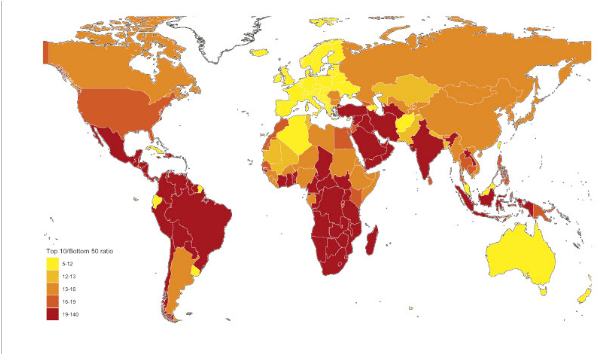
Source: OUTRAS PALAVRAS. O novo mapa da desigualdade global (The new map of global inequality). Available on the website <https://outraspalavras.net/desigualdades-mundo/novo-mapa-da-desigualdade-global/>. Note: The countries in red are those with the greatest social inequality and those in yellow are the countries with the lowest social inequality. Countries in other colors show intermediate social inequality. The more tending towards red, the greater the social inequality.
Global wealth inequalities are even more pronounced than global population income inequalities. The poorest half of the global population barely own any wealth, they have only 2% of the world’s total wealth. In contrast, the richest 10% of the world’s population own 76% of all the wealth on the planet. In Europe, the wealth of the richest 10% is around 36% of the region’s total wealth, while in the Middle East and North Africa this value reaches 58% of the region’s total wealth. Between these two levels, there is a diversity of patterns. In East Asia, the richest 10% own 43% of the region’s total wealth and in Latin America, 55% of the region’s total wealth.
Wealth inequalities have increased among the richest. The increase in private wealth has also been uneven within countries and globally. Global billionaires have enjoyed a disproportionate share of the growth in global wealth in recent decades. The top 1% of global wealth held 38% of all additional wealth accumulated since the mid-1990s, while the bottom 50% held just 2% of global wealth. The wealth of the planet’s richest individuals has grown by 6% to 9% a year since 1995, while average wealth has grown by 3.2% a year. Since 1995, the share of global wealth held by billionaires has increased from 1% to over 3%. This increase was exacerbated during the new coronavirus pandemic. The share of wealth held by the world’s billionaires has increased from 1% of total household wealth in 1995 to nearly 3.5% today. In fact, 2020 marked the sharpest increase in global billionaires’ share of world wealth ever recorded in the world (Figure 2).
FIGURE 2 – Extreme wealth inequality: the rise of global billionaires, 1995-2021

Source: OUTRAS PALAVRAS. O novo mapa da desigualdade global (The new map of global inequality). Available on the website <https://outraspalavras.net/desigualdades-mundo/novo-mapa-da-desigualdade-global/>.
The World Report on Inequalities for 2022 reports that the Middle East and North Africa are the most unequal regions in the world in terms of income and wealth, while Europe has the lowest levels of inequality. Income inequality varies significantly between the most equal region (Europe) and the most unequal region (Middle East and North Africa). Global inequalities appear to be as great today as they were at the height of Western imperialism in the early 20th century. In fact, the share of income currently enjoyed by the poorest half of the world’s population is about half what it was in 1820, before the great rift between Western countries and their colonies.
Nations got richer, but governments got poorer. One way to understand these inequalities is to look at the gap between the net wealth of governments and the net wealth of the private sector. Over the last 40 years, countries have become significantly richer, but their governments have become significantly poorer. The share of wealth held by public actors is close to zero or negative in rich countries, which means that all wealth is in private hands (Figure 3). This trend was amplified by the new Coronavirus pandemic, during which governments went into debt equivalent to 10-20% of GDP, essentially borrowing from the private sector. Today, the little wealth of governments can make it impossible for the national State to promote the development of their countries, overcome income and wealth inequalities in the future, as well as face the main challenges of the 21st century, such as climate change.
FIGURE 3 – Private and public sector wealth in rich countries, 1970-2020

Source: OUTRAS PALAVRAS. O novo mapa da desigualdade global (The new map of global inequality). Available on the website <https://outraspalavras.net/desigualdades-mundo/novo-mapa-da-desigualdade-global/>.
The World Report on Inequalities for 2022 states that existing inequality in all countries of the world is a political choice, not an inevitability. Income and wealth inequalities have increased almost everywhere in the world since the 1980s, following a series of neoliberal programs of deregulation and liberalization that took different forms in different countries. The increase was not uniform. Some countries have experienced spectacular increases in inequality (including the US, Russia and India), while others (European countries and China) have experienced relatively smaller increases.
The World Report on Inequalities for 2022 states that tackling the challenges of the 21st century is not possible without significantly reducing income and wealth inequalities. Furthermore, it argues that the rise of modern Welfare States in the 20th century, which was associated with great progress in health, education and opportunities for all, was associated with the strong increase in progressive taxes and that this played a key role to ensure social and political acceptance of increased taxation and socialization of wealth, as is the case in Scandinavian countries. The World Report on Inequalities for 2022 defends the thesis that a similar evolution will be necessary to face the challenges of the 21st century. Progress towards fairer economic policies is indeed possible, both globally and within countries.
Thomas Piketty has written a book called Capital in the Twenty-First Century, published by Belknap Press of Harvard University Press, Cambridge, Massachusetts, 2014, in which he advocates progressive taxation and global wealth taxation as the only way to arrest the trend of increasing inequality of wealth and income in the capitalist system. It challenges the widely held view that free market capitalism distributes wealth. What Piketty shows statistically is that capital has tended throughout history to produce ever-increasing levels of inequality. This is exactly Marx’s theoretical conclusion, in the first volume of his version of The Capital (Boitempo Editorial, São Paulo, 2013). In Marx’s The Capital, inequality is seen as an inevitable result of the production of wealth under capitalism with the exploitation of workers and not because of the distribution of wealth as Piketty’s Capital in the Twenty-First Century presents.
Piketty explains that there is a trend in the growth of inequality due to the continuous increase in wealth accumulation resulting from the fact that the rate of return on capital always exceeds the rate of growth of income. This, says Piketty, is and has always been “the core contradiction” of capital. In turn, Marx states in his work that social inequality results from the power imbalance between capital and labor. And that explanation still holds true today. The constant fall in the share of labor in national income with contemporary neoliberal globalization since the 1970s is due to the decline in workers’ political power as capital increases the exploitation of workers with rising unemployment resulting from the automation of production and the relocation of companies to more profitable countries and the adoption of policies against workers to destroy any opposition.
The solution proposed by Karl Marx is to overcome inequalities with the end of capitalism and the implementation of socialism and, later, of communism, which is considered utopian by many analysts, given the failure of real socialism implemented in the Soviet Union and in other countries. In turn, the solution proposed by Piketty is to fix the capitalist system and keep it working, which is also considered utopian in the face of the power of capital because he suggests, among other measures, the taxation of large fortunes and the fight against inequality economy and the concentration of wealth in the hands of a few. In short, both proposed solutions would therefore be utopian for many analysts. Another solution would be for governments to adopt an income transfer policy for income-poor populations, which would be unfeasible because most governments would not have enough resources to finance this policy.
However, Eric Hobsbawn offered an answer to this dilemma in an article published in the British newspaper The Guardian on 04/16/2009, under the title Theoretical assumptions of the “mixed economy”, when he stated that we know of two practical attempts to realize both systems, socialist and neoliberal, in its pure form: on the one hand, the state-planned, centralized, Soviet-type economies; on the other hand, the free market capitalist economy free from any restriction and control. The first came crashing down in the 1980s and with them the European communist political systems; the second is decomposing before our eyes in the biggest crisis of global capitalism since the 1929 crash of the New York Stock Exchange.
Hobsbawm said the future belongs to mixed economies in which the public and the private are mutually linked in one way or another. This means that Social Democracy with the Welfare State, the most successful system ever implemented in the world, especially in the Scandinavian countries, which incorporates elements of both socialism and capitalism, could be the solution to the problem of inequality that it overwhelms the planet we live on. One fact is indisputable: as long as capitalism prevails, income and wealth inequalities will increase in all countries of the world, consequently generating an environment of social upheaval, which will result in social revolutions and counter-revolutions that will lead to political instabilities with the implementation of pro-capitalist or anti-capitalist dictatorships. To avoid this scenario of political and social conflagration, the smartest solution is to adopt Social Democracy with the Welfare State along the lines of Scandinavian countries with the necessary adaptation in each country.
* Fernando Alcoforado, awarded the medal of Engineering Merit of the CONFEA / CREA System, member of the Bahia Academy of Education, of the SBPC- Brazilian Society for the Progress of Science and of IPB- Polytechnic Institute of Bahia, engineer and doctor in Territorial Planning and Regional Development from the University of Barcelona, university professor and consultant in the areas of strategic planning, business planning, regional planning, urban planning and energy systems, was Advisor to the Vice President of Engineering and Technology at LIGHT S.A. Electric power distribution company from Rio de Janeiro, Strategic Planning Coordinator of CEPED- Bahia Research and Development Center, Undersecretary of Energy of the State of Bahia, Secretary of Planning of Salvador, is the author of the books Globalização (Editora Nobel, São Paulo, 1997), De Collor a FHC- O Brasil e a Nova (Des)ordem Mundial (Editora Nobel, São Paulo, 1998), Um Projeto para o Brasil (Editora Nobel, São Paulo, 2000), Os condicionantes do desenvolvimento do Estado da Bahia (Tese de doutorado. Universidade de Barcelona,http://www.tesisenred.net/handle/10803/1944, 2003), Globalização e Desenvolvimento (Editora Nobel, São Paulo, 2006), Bahia- Desenvolvimento do Século XVI ao Século XX e Objetivos Estratégicos na Era Contemporânea (EGBA, Salvador, 2008), The Necessary Conditions of the Economic and Social Development- The Case of the State of Bahia (VDM Verlag Dr. Müller Aktiengesellschaft & Co. KG, Saarbrücken, Germany, 2010), Aquecimento Global e Catástrofe Planetária (Viena- Editora e Gráfica, Santa Cruz do Rio Pardo, São Paulo, 2010), Amazônia Sustentável- Para o progresso do Brasil e combate ao aquecimento global (Viena- Editora e Gráfica, Santa Cruz do Rio Pardo, São Paulo, 2011), Os Fatores Condicionantes do Desenvolvimento Econômico e Social (Editora CRV, Curitiba, 2012), Energia no Mundo e no Brasil- Energia e Mudança Climática Catastrófica no Século XXI (Editora CRV, Curitiba, 2015), As Grandes Revoluções Científicas, Econômicas e Sociais que Mudaram o Mundo (Editora CRV, Curitiba, 2016), A Invenção de um novo Brasil (Editora CRV, Curitiba, 2017), Esquerda x Direita e a sua convergência (Associação Baiana de Imprensa, Salvador, 2018), Como inventar o futuro para mudar o mundo (Editora CRV, Curitiba, 2019), A humanidade ameaçada e as estratégias para sua sobrevivência (Editora Dialética, São Paulo, 2021), A escalada da ciência e da tecnologia e sua contribuição ao progresso e à sobrevivência da humanidade(Editora CRV, Curitiba, 2022)and a chapter in the book Flood Handbook (CRC Press, Boca Raton, Florida, United States, 2022).

 Site Title