Fernando Alcoforado*
The Palestinian group Hamas launched an unprecedented attack against Israel, with its fighters entering communities close to the Gaza Strip, killing more than 900 people and taking hostages. In response, the Israeli government has launched airstrikes that have left almost 690 people dead in Gaza and another 3,700 injured. This was the most ambitious operation Hamas has ever launched from Gaza and the most serious attack Israel has faced in more than a generation. The terrorist act carried out by Hamas fighters against Israeli citizens resulted in, in response, the Israeli government’s barbaric and brutal treatment of the Palestinian people and the threat of an invasion of the Gaza Strip under Hamas control by the armed forces. Israelis.
The new fact regarding Hamas concerns the increase in its arsenal of missiles and drones supplied by Iran that can even reach the outskirts of Tel Aviv and Jerusalem. These new weapons are far from creating a “balance of terror” between the two camps. Israel still has immensely superior firepower and deterrence capacity, in addition to having a very efficient anti-missile shield. The Israeli massacre against the Palestinians in the Gaza Strip could become the trigger not only for a new war between Israel and Palestinian people and evolve into a new regional conflict involving Iran and Arab countries, and also a global one with the participation of major military powers. The feeling of revolt generated by the deaths of innocent people in Israel by Jews and in the Gaza Strip by Palestinians is yet another element contrary to the rapprochement of the Palestinian and Israeli peoples.
The escalation of the war is ongoing with the mobilization of thousands of reservists promoted by the Israeli government. There is no doubt that a war plan is being carried out by the Israeli government, with the next step being a land invasion of the Gaza Strip to annihilate Hamas. At this time, the main roads around the Gaza Strip are being blocked, to facilitate the military operation that is being carried out. This military operation launched by Benjamin Netanyahu, Israeli Prime Minister, would also aim to strengthen him politically after the failure of Israel’s defenses with the recent terrorist action by Hamas. The danger of this Israeli offensive against the Palestinians in the Gaza Strip could mean the involvement of Egypt and other Arab countries against Israel.
The worst case scenario would be the evolution of a localized conflict, Israel versus Palestinians in the Gaza Strip, into a regional war involving all countries in the region. The conflict between the State of Israel and the Palestinians therefore includes local and regional dimensions. The transition from a regional war to a global conflict can also happen with the involvement of the great military powers (United States, Russia and China) in defending their interests and those of their allies in the region. The local dimension of the conflict is one that pits the interests of two peoples against one another: the Palestinian and the Jewish over the occupation of the same disputed territory. The regional dimension concerns, on the one hand, the confrontation between Israel and Iran in which Israel seeks to prevent Iran from becoming a nuclear power that threatens its security and, on the other hand, between Israel and Arab countries that could unite together with Iran against Israel in solidarity with the Palestinian people.
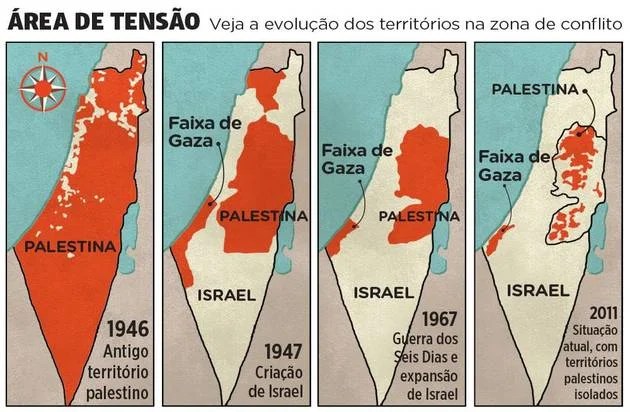
The concrete fact is that Israel occupies 78% of Palestine, leaving the Palestinians with only 22% of the territory, that is, the West Bank and the Gaza Strip, a situation that is unacceptable for the Palestinian people. While the conflict between the State of Israel and the Palestinian people remains unresolved, the Israeli government arbitrarily continues to expand its territory in Palestine with Jewish settlements against all UN Security Council Resolutions. The conflict between the State of Israel and the Palestinian people will only come to an end if the Palestinians take control of their territories and establish a sovereign and independent Palestinian State and if Israel ensures the defense of its territory against its enemies. Most Palestinians accept the West Bank and Gaza Strip regions as territory for a future Palestinian state. Many Israelis also accept this solution. For an agreement between the parties to be possible, it would be necessary to resolve the main points of contention, which are the status of Jerusalem and the fate of Palestinian refugees and Jewish settlements.
The conflict between the State of Israel and the Palestinian people may to an end and the regional conflict between Israel and Iran and Arab countries will be avoided if the world’s great military powers and the UN Security Council initially resolve the conflict between the State of Israel and the Palestinian people and then the conflicts involving Israel, Iran and Arab countries. The continuation of the conflict between the State of Israel and the Palestinian people is therefore contrary to strategic stability in the region and the world. In addition to taking on a local and regional dimension, the conflict between the State of Israel and the Palestinian people can become global due to the fact that it is considered the matrix of a possible clash of civilizations. Representing Western civilization are the United States and Israel in which Jews are seen as assimilated into Western civilization despite their origins in the disputed region of Palestine, and representing Islamic civilization are the Palestinian National Authority, Hamas, Iran and the countries Arabs. It is unlikely that the conflict between Palestinians and Jews will be resolved today because existing international institutions are not capable of building a negotiated solution to the conflict between the Jewish and Palestinian peoples and between Israel, Iran and Arab countries.
The United States has lost the ability to mediate any conflict in the world, no great power has the conditions to play this role and the UN is currently incapable of promoting peace on a local, regional or global levels. Under these circumstances, the outbreak of a new world war may become inevitable. Until humanity equips itself as urgently as possible with the global instruments necessary to control its destiny, it will be impossible to prevent the occurrence of wars and ensure the survival of the human species on the planet. If everything continues as it is, no structure, not even the UN, which works, in practice, in the service of the interests of the great powers, especially the United States, will be able to exercise governance over planet Earth. Most likely, there will be increasing radicalization among Palestinians and Jews, between Israel and Iran and Arab countries, and between Western Civilization and Islamic Civilization.
This conflict in the Middle East adds to the conflict between Russia and Ukraine, increasing the risks of a new world war that, if it breaks out, will mean the extermination of humanity with the possible use of nuclear weapons by the contenders in possession of these weapons. The time has come when humanity should have an effective international system to definitively ward off new risks of a new world war and to achieve perpetual peace on our planet. To achieve this, it would be necessary to reform the current international system, which is incapable of guaranteeing world peace. The new international system should work based on a Planetary Social Contract that would be the Constitution of planet Earth. To prepare the Planetary Social Contract, a Constituent World Assembly should be convened with the participation of representatives from all countries in the world elected for this purpose. The Planetary Social Contract should establish the existence of a world Government and a world Parliament elected to exercise governance on planet Earth and mediate international conflicts and a world Supreme Court to judge cases involving disputes between countries, crimes against humanity and against nature practiced by national States and rulers in light of the Planetary Social Contract, judge conflicts that exist between the world government and the world parliament and act as guardian of the Planetary Social Contract to make perpetual peace on our planet possible.
* Fernando Alcoforado, awarded the medal of Engineering Merit of the CONFEA / CREA System, member of the Bahia Academy of Education, of the SBPC- Brazilian Society for the Progress of Science and of IPB- Polytechnic Institute of Bahia, engineer from the UFBA Polytechnic School and doctor in Territorial Planning and Regional Development from the University of Barcelona, college professor (Engineering, Economy and Administration) and consultant in the areas of strategic planning, business planning, regional planning, urban planning and energy systems, was Advisor to the Vice President of Engineering and Technology at LIGHT S.A. Electric power distribution company from Rio de Janeiro, Strategic Planning Coordinator of CEPED- Bahia Research and Development Center, Undersecretary of Energy of the State of Bahia, Secretary of Planning of Salvador, is the author of the books Globalização (Editora Nobel, São Paulo, 1997), De Collor a FHC- O Brasil e a Nova (Des)ordem Mundial (Editora Nobel, São Paulo, 1998), Um Projeto para o Brasil (Editora Nobel, São Paulo, 2000), Os condicionantes do desenvolvimento do Estado da Bahia (Tese de doutorado. Universidade de Barcelona,http://www.tesisenred.net/handle/10803/1944, 2003), Globalização e Desenvolvimento (Editora Nobel, São Paulo, 2006), Bahia- Desenvolvimento do Século XVI ao Século XX e Objetivos Estratégicos na Era Contemporânea (EGBA, Salvador, 2008), The Necessary Conditions of the Economic and Social Development- The Case of the State of Bahia (VDM Verlag Dr. Müller Aktiengesellschaft & Co. KG, Saarbrücken, Germany, 2010), Aquecimento Global e Catástrofe Planetária (Viena- Editora e Gráfica, Santa Cruz do Rio Pardo, São Paulo, 2010), Amazônia Sustentável- Para o progresso do Brasil e combate ao aquecimento global (Viena- Editora e Gráfica, Santa Cruz do Rio Pardo, São Paulo, 2011), Os Fatores Condicionantes do Desenvolvimento Econômico e Social (Editora CRV, Curitiba, 2012), Energia no Mundo e no Brasil- Energia e Mudança Climática Catastrófica no Século XXI (Editora CRV, Curitiba, 2015), As Grandes Revoluções Científicas, Econômicas e Sociais que Mudaram o Mundo (Editora CRV, Curitiba, 2016), A Invenção de um novo Brasil (Editora CRV, Curitiba, 2017), Esquerda x Direita e a sua convergência (Associação Baiana de Imprensa, Salvador, 2018), Como inventar o futuro para mudar o mundo (Editora CRV, Curitiba, 2019), A humanidade ameaçada e as estratégias para sua sobrevivência (Editora Dialética, São Paulo, 2021), A escalada da ciência e da tecnologia e sua contribuição ao progresso e à sobrevivência da humanidade (Editora CRV, Curitiba, 2022), a chapter in the book Flood Handbook (CRC Press, Boca Raton, Florida United States, 2022) and How to protect human beings from threats to their existence and avoid the extinction of humanity (Generis Publishing, Europe, Republic of Moldova, Chișinău, 2023).

 Site Title