Fernando Alcoforado*
This article aims to present that the world has lived for many years with the existence of extreme wealth and extreme poverty among human beings and with the existence of very few rich countries that present advanced economic and social development alongside the vast majority of poor countries with precarious economic and social development. The stark contrast in the world and in each country between the excessive concentration of wealth and the presence of huge population groups subjected to hunger, poverty and misery is clear proof of the absolute failure of capitalism as a civilizing project. This situation imposes the need for changes to occur in the capitalist society in which we live to overcome social and wealth inequalities in the world in the contemporary era.
The analysis of income and wealth inequalities in the world, based on the Relatório Mundial sobre as Desigualdades para 2022 (World Report on Inequalities for 2022) produced by Thomas Piketty’s team from the Paris School of Economics published on the website <https://outraspalavras.net/desigualdades-mundo/novo-mapa-da-desigualdade-global/>, allows us to conclude that the richest 10% of the global population currently appropriate 52% of global income, while the poorest half of the population earns 8% of world income. The world map of social inequality (Figure 1) reveals that, among high-income countries, some are very unequal, like the United States, while others are relatively egalitarian, like, for example, Sweden. The same goes for low- and middle-income countries, with some exhibiting extreme inequality like, for example, Brazil and India, somewhat high levels like China, and moderate to relatively low levels, like, for example, Malaysia and Uruguay. In Brazil, the poorest 50% earn 29 times less than the richest 10%. This value is 7 times lower in France.
Figure 1 – World map of social inequality

Source: OUTRAS PALAVRAS (OTHER WORDS). The new map of global inequality. Available on the website <https://outraspalavras.net/desigualdades-mundo/novo-mapa-da-desigualdade-global/>. Note: The countries in red color are those with the greatest social inequality and those in yellow color are the countries with the lowest social inequality. Countries in other colors have intermediate social inequality. The more it tends towards red, the greater the social inequality.
The Relatório Mundial sobre as Desigualdades para 2022 (World Inequalities Report for 2022) reports that global wealth inequalities are even more pronounced than global population income inequalities. The poorest half of the global population barely has any wealth, they have just 2% of the world’s total wealth. In contrast, the richest 10% of the world’s population own 76% of all the wealth on the planet. In Europe, the wealth of the richest 10% is around 36% of the region’s total wealth, while in the Middle East and North Africa this figure reaches 58% of the region’s total wealth. Between these two levels, there is a diversity of standards. In East Asia, the richest 10% own 43% of the region’s total wealth and in Latin America, 55% of the region’s total wealth.
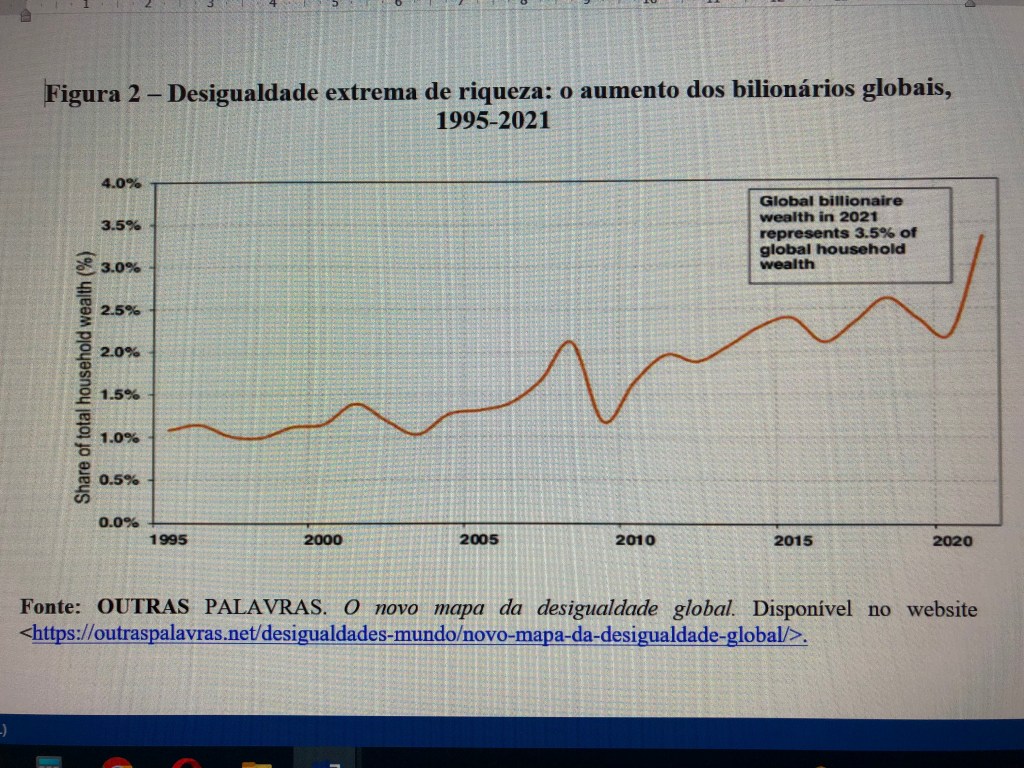
The Relatório Mundial sobre as Desigualdades para 2022 (World Inequalities Report) for 2022 reports that wealth inequalities have increased among the richest countries. The increase in private wealth was also uneven within countries and globally. Global billionaires have earned a disproportionate share of the growth in global wealth in recent decades. The top 1% of global wealth got 38% of all additional wealth accumulated since the mid-1990s, while the bottom 50% got just 2% of global wealth. The wealth of the planet’s richest individuals has grown 6% to 9% per year since 1995, while the average wealth has grown 3.2% per year. Since 1995, the share of global wealth held by billionaires has increased from 1% to more than 3%. This increase was exacerbated during the new Coronavirus pandemic. The share of wealth owned by the world’s billionaires has increased from 1% of total household wealth in 1995 to almost 3.5% today. In fact, 2020 marked the sharpest increase in global billionaires’ share of global wealth ever recorded in the world (Figure 2).
Figure 2 – Extreme wealth inequality: the rise of global billionaires, 1995-2021
Source: OUTRAS PALAVRAS (OTHER WORDS). The new map of global inequality. Available on the website <https://outraspalavras.net/desigualdades-mundo/novo-mapa-da-desigualdade-global/>.
The Relatório Mundial sobre as Desigualdades para 2022 (World Inequalities Report for 2022) reports that the Middle East and North Africa are the most unequal regions in the world in terms of income and wealth, while Europe has the lowest levels of inequality. Income inequality varies significantly between the most equal region (Europe) and the most unequal region (Middle East and North Africa). Global inequalities appear to be as great today as they were at the height of Western imperialism in the early 20th century. In fact, the share of income currently earned by the poorest half of the world’s population is about half of what it was in 1820, before the great rupture between Western countries and their colonies.
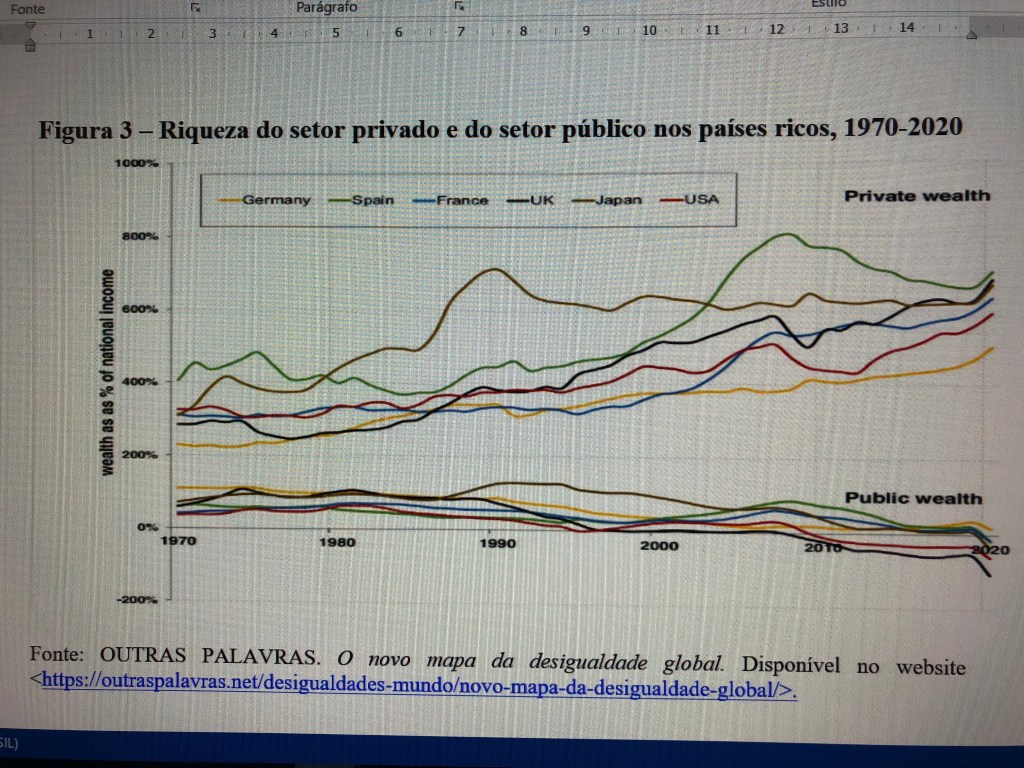
The Relatório Mundial sobre as Desigualdades para 2022 (World Inequalities Report for 2022) reports that nations have become richer, but governments have become poorer. One way to understand these inequalities is to look at the gap between the net wealth of governments and the net wealth of the private sector. Over the past 40 years, countries have become significantly richer, but their governments have become significantly poorer. The share of wealth held by public actors is close to zero or negative in rich countries, which means that all wealth is in private hands (Figure 3). This trend was amplified by the new Coronavirus pandemic, during which governments took on debt equivalent to 10-20% of GDP, essentially raising funds from the private sector. Our conclusion is that, currently, the little wealth available by national governments can hinder the ability of the national State to promote the development of their countries, overcome income and wealth inequalities in the future, as well as face the main challenges of the 21st century, such as climate change.
Figure 3 – Private sector and public sector wealth in rich countries, 1970-2020
Source: OUTRAS PALAVRAS (OTHER WORDS). The new map of global inequality. Available on the website <https://outraspalavras.net/desigualdades-mundo/novo-mapa-da-desigualdade-global/>.
The Relatório Mundial sobre as Desigualdades para 2022 (World Inequalities Report for 2022) informs that the inequality that exists in every country in the world is a political choice, not an inevitability. Income and wealth inequalities have increased across most of the world since the 1980s, following a series of neoliberal deregulation and liberalization programs that took different forms in different countries. The increase was not uniform. Some countries have experienced spectacular increases in inequality (including the United States, Russia, and India), while others (European countries and China) have experienced relatively smaller increases.
The Relatório Mundial sobre as Desigualdades para 2022 (World Inequalities Report for 2022) informs that facing the challenges of the 21st century is not possible without a significant reduction in income and wealth inequalities. Furthermore, it argues that the rise of modern welfare states in the 20th century, which was associated with great progress in health, education and opportunities for all, was associated with strong increases in progressive taxes and that this played a key role to ensure social and political acceptance of increased taxation and socialization of wealth, as is the case in Scandinavian countries. The Relatório Mundial sobre as Desigualdades para 2022 (World Inequalities Report for 2022) presents the thesis that similar developments will be necessary for countries around the world to face the challenges of the 21st century. Progress towards fairer economic policies is indeed possible, both globally and within countries.
The new report by Oxfam Desigualdade S.A. (Inequality S.A.), available on the website <https://www.oxfam.org.br/noticias/os-cinco-homens-mais-ricos-do-mundo-dobraram-suas-fortunas-desde-2020- while-five-billion-people-became-poorer/>, launched during the Davos World Economic Forum, which brings together global political and economic leaders, and released on January 15th, reaches conclusions similar to those of the World Inequalities Report for 2022 produced by Thomas Piketty’s team from the Paris School of Economics. In summary, the new report from Oxfam Desigualdade S.A. (Inequality S.A.) states the following:
- The five richest men in the world have more than doubled their fortunes since 2020 – from US$405 billion to US$869 billion -, at a rate of US$14 million per hour, while almost five billion people have become poorer. The wealth of the five richest men in the world has increased by 114% since 2020.
- If current trends continue, the world will have its first trillionaire within a decade, but poverty will not be eradicated for another 229 years.
- The world’s 148 largest companies earned $1.8 trillion, 52% more than the average over the past three years, and distributed hefty dividends to wealthy shareholders while millions of people faced pay cuts.
- Despite representing only 21% of the global population, the richest countries in the Global North hold 69% of global wealth and have 74% of the wealth of the world’s billionaires.
- The richest 1% in the world own 43% of all global financial assets – 48% in the Middle East, 50% in Asia and 47% in Europe.
- For every US$100 of profit made by each of the world’s 96 largest companies between July 2022 and June 2023, US$82 was paid to their richest shareholders.
- People around the world are working longer and longer, often for low wages and precarious, insecure jobs. The salaries of almost 800 million workers have not kept up with inflation and have lost US$1.5 trillion in the last two years (or 25 days of lost wages for each worker).
- Billionaires are US$3.3 trillion richer than in 2020 and their wealth grew three times faster than the inflation rate in the period.
- The “war on taxation” by corporations has resulted in a significant reduction in corporate tax, to a third of what was practiced in recent decades, while these corporations privatized the public sector, segregating services such as education and water.
Regarding Brazil, the Oxfam Desigualdade S.A. (Inequality S.A.) report states the following:
- Four of the five richest Brazilian billionaires have seen their wealth increase by 51% since 2020; at the same time, 129 million Brazilians became poorer.
- The richest person in the country has a fortune equivalent to the poorest half of Brazil (107 million people).
- The richest 1% in Brazil owns 60% of the country’s financial assets.
- On average, the income of white people is more than 70% higher than the income of black people.
To overcome inequality across the world, Oxfam suggests that governments drastically reduce the gap between the super-rich and the rest of society by:
- Revitalization of the State. A dynamic and efficient State is the best mechanism against extreme corporate power. Governments should ensure universal healthcare and education and explore key sectors such as energy and transport.
- Control of corporate power, including through breaking up monopolies and democratizing patent rules. This also means legislating living wages, capping CEO salaries, and creating new taxes on the super-rich and corporations, including taxes on permanent wealth and excess profits. Oxfam estimates that a wealth tax on the world’s millionaires and billionaires could generate $1.8 trillion a year.
- Business reinvention. Competitive and profitable companies do not need to be shackled by shareholder greed. Democratically owned companies better equalize business income. If just 10% of U.S. businesses were worker-owned, it could double the wealth share of the poorest half of the U.S. population, including doubling the median wealth of Black families.
The main conclusion drawn from the World Report on Inequalities for 2022 produced by Thomas Piketty’s team and Oxfam’s Inequality S.A. report is that income and wealth inequalities are growing in the world and in Brazil, where most of them are absorbed by a small portion of the rich population to the detriment of the vast majority of the poor population and the majority of them are absorbed by the private sector to the detriment of the public sector. Many ask why there are income and wealth disparities in the world and how to overcome them? To answer this question, it is important to note that wealth and poverty cannot be treated in isolation, since they are the sides of the same coin forming an irreducible set. Wealth and poverty constitute a “zero-sum game”. That is, the gain of the rich occurs with the loss of the poor and vice versa. To increase the income and wealth of rich populations and countries, it is necessary to prevent the increase in income and wealth of poor populations and countries and to increase the income and wealth of poor populations and countries, it is necessary to reduce income and the wealth of populations and rich countries. The analysis of wealth cannot be dissociated from poverty, as the concentration of wealth generates exploitation of man-by-man, which constitutes a fundamental element of poverty.
There is a widespread thought that the causes of misery and poverty are linked to family imbalances, the individual’s educational unpreparedness for the world of work and the individual’s lack of capacity to undertake. As will be presented in the following paragraphs, the causes of poverty are related to social inequalities resulting from the concentration of wealth in capitalism as demonstrated in the World Report on Inequalities for 2022 and in Oxfam’s Inequality S.A. report. Why associate poverty with capitalist society, if there has always been poverty and inequality throughout human history before capitalism? Does this phenomenon, always present in different social organizations throughout the history of humanity, present some central characteristic in the capitalist mode of production, different from other social systems such as slavery and feudalism that preceded capitalism? Does capitalism generate poverty that is based on different foundations than in other societies?
According to Karl Marx, all wealth in capitalist society is the product of labor, created by the physical and mental efforts of the working class. Profits, which mean the return on capital, are as Marx explained in Capital (Boitempo Editorial, São Paulo, 2013) nothing more than the work not paid to the working class, that is, the difference between the value that is produced of good or service and the value that accrues to workers in the form of wages. An increasing rate of profit, therefore, only implies an increasing exploitation of the working class, which necessarily means a greater part of the wealth in society accumulating in the hands of the capitalists, that is, the holders of the means of production. Marx demonstrated in his three volumes of Capital how, through various means, capitalism can exploit the working class for greater profits, for example: 1) extending the working day, through an intensification of work within a given time; and, 2) increasing the efficiency and productivity of workers, through the replacement of work with machines, etc. All of this is reflected in the increase in the proportion of unpaid work in relation to the value of what is produced by workers.
In capitalist society, it is not precarious development that generates social inequality and poverty, as many think, but capitalist development itself. In capitalism, the greater the accumulation of capital, the greater the wealth and the greater the poverty. The more wealth the worker produces, the greater the exploitation, the more wealth is expropriated (from the worker) and appropriated (by the capitalist). Thus, it is not scarcity that generates poverty, but abundance (with the concentration of wealth in a few hands) that generates absolute and relative inequality and pauperization. Thomas Piketty, a French economist, wrote a book called Capital in the Twenty-First Century, published by The Belknap Press of Harvard University Press, Cambridge, Massachusetts, 2014. In this book, Piketty calls into question the largely accepted, that free market capitalism distributes wealth. What Piketty shows statistically is that capital has tended, throughout history, to produce increasingly greater levels of social inequality with the concentration of wealth. This is exactly the theoretical conclusion of Karl Marx, in the first volume of his version of Capital (Boitempo Editorial, São Paulo, 2013). In Marx’s Capital, inequality is seen not as the result of the distribution of wealth as Piketty’s Capital in the 21st Century presents, but as an inevitable result of the production of wealth under capitalism. Today we have fewer and fewer families holding almost half of global wealth.
In Brazil, data from IBGE (Brazilian Institute of Geography and Statistics) shows that the monthly income of the richest 1% in the country is almost 34 times greater than the income of the poorest half of the population. This data shows that the income of the poorest 5% fell by 3%, while the income of the richest 1% increased by 8%. Around 889 thousand people are considered rich in Brazil. This number represents just 0.42% of the Brazilian population. Approximately 45 million Brazilians live on a monthly income that is less than the minimum wage. The population living in poverty in Brazil, according to the most recent IBGE data, corresponds to 52 million inhabitants, of which 15 million people are in extreme poverty. Among those who live in extreme poverty and are homeless in Brazil are approximately 221,869 people according to the Institute for Applied Economic Research (IPEA). Poor people are also those who do not own homes, who do not enjoy the right to housing, which totaled 5.8 million homes in 2019, of which 79% were concentrated in low-income families.
The stark contrast between the colossal economic, scientific and technological development achieved by humanity and the presence of immense population groups subjected to hunger, poverty and misery is clear proof of the absolute failure of capitalism as a civilizing project. Two and a half centuries after the Industrial Revolution, which consolidated the material bases of the capitalist mode of production, triggering an exponential increase in labor productivity, more than 1/4 of humanity still lives the scourge of hunger, poverty and misery on a daily basis. This problem lies in the extreme concentration of income and wealth. In a completely commercialized society, those who are deprived of money have no means of accessing food. The growing gap between the unbridled expansion of wealth and the perpetuation of poverty with gigantic social needs is an inherent reality of the capital-labor relationship. Hunger, poverty and misery for a large portion of the population are the maximum expression of social inequality inherent to the capitalist mode of production. The presence of a large mass of impoverished workers who live on the threshold of biological survival lowers the traditional standard of living for all workers. Large-scale poverty and misery thus function as an anchor that reduces the cost of reproducing the workforce, enhancing the extraction of surplus value and increasing the rate of profit. The relationship between the accumulation of wealth and the accumulation of poverty is direct and inexorable.
Is it possible to overcome social and wealth inequalities in capitalism? Oxfam suggests that governments drastically reduce the gap between the super-rich and the rest of society, by revitalizing the national state making it efficient and effective, controlling corporate power by breaking up private monopolies, democratizing the rules of patents, living wage legislation, limiting CEO salaries, and creating new taxes on the super-rich and corporations, including permanent taxes on wealth and excess profits, and the reinvention of business through the democratization of corporate capital. This proposal will only be able to be implemented if the Welfare State is implemented along the lines of that practiced in the Scandinavian countries (Sweden, Denmark, Norway, Finland and Iceland) with the necessary adaptation to each country because is the most successful social system already implemented in the world and it is the cradle of the most egalitarian model of society that capitalism has ever known.
The origin of the welfare state along the lines of that practiced in Scandinavian countries dates back to Sweden in the 1930s, when social democratic hegemony took shape in the government of the Nordic country, initiating a series of social and economic reforms that would inaugurate a new type of capitalism, as opposed to the failed economic liberalism of previous decades. The so-called Scandinavian model of development was then born, which would quickly surpass Swedish borders to become influential in northern Europe, but also became an important reference in the formulation of heterodox (progressive) economic policies across the planet. The success of the Scandinavian countries’ model of society was due to the combination of a broad Welfare State with rigid mechanisms for regulating market forces, capable of placing the economy on a dynamic trajectory, while at the same time achieving the best indicators of social well-being among capitalist countries.
The World Happiness Report 2020 shows that the happiest nations in the world are in Scandinavia. This fact proves the success of the welfare state along the lines of that practiced in Scandinavian countries. Nordic countries rank highest in real GDP per capita, highest healthy life expectancy, greatest freedom to make life choices and greatest generosity. This model of society should be adopted as a solution to reduce social inequalities in the world because, throughout the history of humanity, capitalism has failed to build an economically, socially and politically fair and humane society in several countries, leaving social barbarity as a legacy of the extreme wealth and extreme poverty that characterizes the world in which we live. To end social barbarity, promote economic and social progress and establish civilized coexistence among all human beings, it is urgent to build a new model of society in each country in the world, which is, therefore, the Social Welfare State along the lines Scandinavians adapted to the conditions of each country.
* Fernando Alcoforado, awarded the medal of Engineering Merit of the CONFEA / CREA System, member of the Bahia Academy of Education, of the SBPC- Brazilian Society for the Progress of Science and of IPB- Polytechnic Institute of Bahia, engineer from the UFBA Polytechnic School and doctor in Territorial Planning and Regional Development from the University of Barcelona, college professor (Engineering, Economy and Administration) and consultant in the areas of strategic planning, business planning, regional planning, urban planning and energy systems, was Advisor to the Vice President of Engineering and Technology at LIGHT S.A. Electric power distribution company from Rio de Janeiro, Strategic Planning Coordinator of CEPED- Bahia Research and Development Center, Undersecretary of Energy of the State of Bahia, Secretary of Planning of Salvador, is the author of the books Globalização (Editora Nobel, São Paulo, 1997), De Collor a FHC- O Brasil e a Nova (Des)ordem Mundial (Editora Nobel, São Paulo, 1998), Um Projeto para o Brasil (Editora Nobel, São Paulo, 2000), Os condicionantes do desenvolvimento do Estado da Bahia (Tese de doutorado. Universidade de Barcelona,http://www.tesisenred.net/handle/10803/1944, 2003), Globalização e Desenvolvimento (Editora Nobel, São Paulo, 2006), Bahia- Desenvolvimento do Século XVI ao Século XX e Objetivos Estratégicos na Era Contemporânea (EGBA, Salvador, 2008), The Necessary Conditions of the Economic and Social Development- The Case of the State of Bahia (VDM Verlag Dr. Müller Aktiengesellschaft & Co. KG, Saarbrücken, Germany, 2010), Aquecimento Global e Catástrofe Planetária (Viena- Editora e Gráfica, Santa Cruz do Rio Pardo, São Paulo, 2010), Amazônia Sustentável- Para o progresso do Brasil e combate ao aquecimento global (Viena- Editora e Gráfica, Santa Cruz do Rio Pardo, São Paulo, 2011), Os Fatores Condicionantes do Desenvolvimento Econômico e Social (Editora CRV, Curitiba, 2012), Energia no Mundo e no Brasil- Energia e Mudança Climática Catastrófica no Século XXI (Editora CRV, Curitiba, 2015), As Grandes Revoluções Científicas, Econômicas e Sociais que Mudaram o Mundo (Editora CRV, Curitiba, 2016), A Invenção de um novo Brasil (Editora CRV, Curitiba, 2017), Esquerda x Direita e a sua convergência (Associação Baiana de Imprensa, Salvador, 2018), Como inventar o futuro para mudar o mundo (Editora CRV, Curitiba, 2019), A humanidade ameaçada e as estratégias para sua sobrevivência (Editora Dialética, São Paulo, 2021), A escalada da ciência e da tecnologia e sua contribuição ao progresso e à sobrevivência da humanidade (Editora CRV, Curitiba, 2022), a chapter in the book Flood Handbook (CRC Press, Boca Raton, Florida United States, 2022), How to protect human beings from threats to their existence and avoid the extinction of humanity (Generis Publishing, Europe, Republic of Moldova, Chișinău, 2023) and A revolução da educação necessária ao Brasil na era contemporânea (Editora CRV, Curitiba, 2023).

 Site Title