Fernando Alcoforado*
This article aims to present and analyze the report of the Intergovernmental Panel on Climate Change (IPCC), an agency linked to the UN, released on August 9, 2021 through which it shows all the knowledge acquired since the publication of its previous report in 2014 on the climate of planet Earth. 234 authors from 66 countries reviewed more than 14,000 scientific studies and their work was received with over 78,000 comments and observations from researchers and experts working for the 195 governments for which this work is intended. This report reveals a deepening knowledge of the Earth’s past, present and future climate. Summary of this report can be read in the article Selon le GIEC, le changement climatique est irréversible, mais peut encore être corrigé (Climate change is irreversible, but can still be corrected, says IPCC) available on the website <https://www.sciencesetavenir.fr/nature-environnement/climat/selon-le-giec-le-changement-climatique-s-accelere-est-irreversible-mais-peut-etre-corrige_156431>.
In this IPCC report, the Earth’s temperature variation from year 1 to 2020 was graphically presented. Figure 1 shows the Earth’s temperature variation from year 1 to 2020 and that caused by natural causes (solar and volcanic) and by man from 1850 to 2020.
Figure 1- Earth’s temperature variation
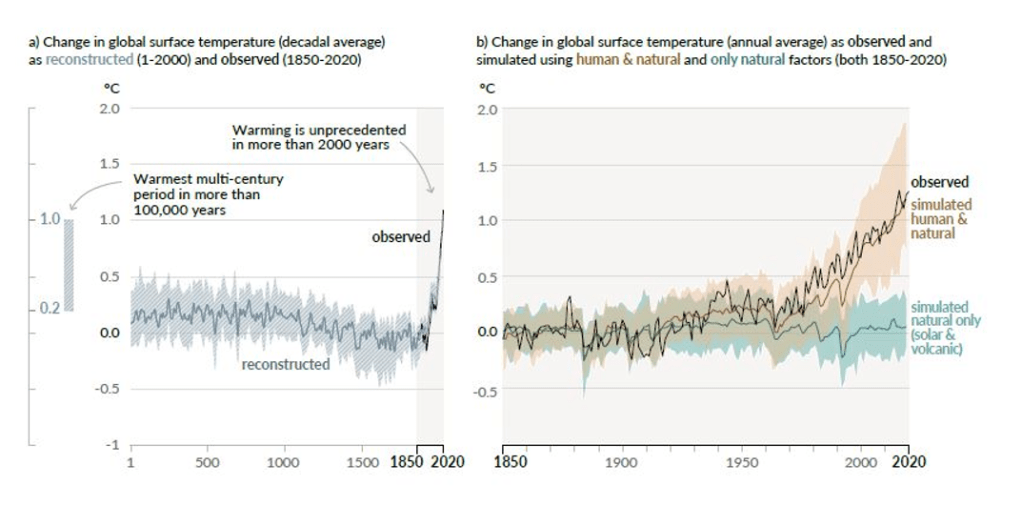
In this figure, it can be seen that the Earth’s temperature variation decreased from year 1 to 1850, however, from this time onwards, which corresponds to the 1st Industrial Revolution in England, there was an accelerated growth of this unprecedented variation in 2000 years, evolving from zero to reach 1.1 °C by 2020. The global temperature on the Earth’s surface between 2000 and 2020 was 1.1 °C higher than the average between 1850 and 1900. There is a rapid increase in temperatures never seen before. It is higher on the continents (1.59 °C) than in the oceans (0.88 °C). It can also be observed that, from 1850 to the year 2020, it was evidenced that human (anthropic) activity is responsible for the increase in temperature variation observed on the planet because it was found that there was no variation in the solar and volcanic contribution of 1850 to 2020. There is no longer any doubt that Man is really at the origin of the current phenomenon. It is unmistakable that human influence has warmed the atmosphere, oceans and soil. The certainty that the ongoing climate change is caused by human emissions was evidenced, it is irreversible, but can be corrected if there is strong and coordinated action by all countries in the world, according to the IPCC.
According to the IPCC, in the last decade, all records of man-made greenhouse gas emissions were broken. Concentrations continued to increase. In 2019, it was 410 parts per million (ppm) for CO2, 1866 parts per billion (ppb) for methane (CH4) and 332 ppb for nitrous oxides (N20). 56% of these emissions are absorbed by the ocean and by vegetation and soils. 44% of annual emissions, therefore, accumulate in the atmosphere and cause an increase in the greenhouse effect. In 2019, CO2 concentrations were at levels not seen on the planet for at least 2 million years, and methane and N2O for 800,000 years. Since 1750, CO2 levels have increased by 47%, methane by 156% and N2O by 23%.
The IPCC report points out disturbances in the water cycle stating that, globally, it rains more on Earth today than in 1950 and has accelerated since 1980. As a result, floods are more frequent in some regions of the planet while periods of drought multiply and extend into other regions. The number of the strongest cyclones has increased over the past four decades, but there is no certainty that their total number will increase. In the North Pacific, these storms are now occurring at higher latitudes. Sea level rose 20 centimeters between 1901 and 2018. The ocean warmed more in the 20th century than it has since the end of the last ice age, 11,000 years ago, which marked the beginning of the Holocene. Sea level rise is caused both by thermal expansion due to rising water temperatures and by melting glaciers, arctic sea ice and the Greenland ice sheet. The report details for the first time the responsibility of both. Thermal expansion explains 50% of rising seas, while glaciers contributed 22%, ice caps 20% and water storage in dams 8%.
The IPCC report says that Arctic ice melts very quickly. The rate of melting of the polar ice caps quadrupled between 1992-1999 and 2010-2019. Together, ice caps and glaciers became the most important contributors to sea level rise between 2006 and 2018. Arctic sea ice saw its surface area shrink by 40% in September between 1979-1988 and 2010-2019, and 10% in March between the same two periods. There is a tendency for extreme events to become more and more violent and numerous. The link between climate change and the most severe weather events is increasingly well established. Heat waves have been more frequent and intense in most parts of the world since the 1950s, while stronger cold waves have become less frequent. Fires and floods are also more violent. The occurrence of the very destructive episodes of the last decades would not have been possible with this intensity without the influence of man. Every additional 0.5 °C will cause a very significant increase in the intensity and frequency of extreme events, including heat waves and very heavy rainfall. The permanence of CO2 in the atmosphere is one hundred years. Each ton emitted adds to those released in previous decades. This inertia implies that global warming will continue even if fossil fuel use drops dramatically after 2021.
The IPCC report outlined scenarios for the evolution of temperature and the emission of greenhouse gases, pointing out that, compared to the period 1850-1900, the Earth’s surface temperature between 2081 and 2100 is expected to be 1°C to 1.8°C higher under scenarios of dramatic drop in greenhouse gas emissions, from 2.1 °C to 3.5 °C in the intermediate scenarios and up to 5.7 °C if nothing is done. The last time the Earth’s surface temperature was 2.5 °C higher than in the period 1850-1900 was 3 million years ago. Three current phenomena cannot be stopped today: the rise in ocean temperature, the melting of the Greenland ice sheet and the rise in sea level, as there is a linear relationship between these events and the CO2 content in the atmosphere. The carbon sinks that are the ocean and the Earth’s vegetation cover will become less and less efficient. In the current state of greenhouse gas emissions and given the commitments made by countries to reduce their emissions under the Paris Agreement, 1.5 °C will be exceeded in less than 20 years. Only coordinated, intense and powerful action to convert the world economy into an economy based on the use of clean technologies and renewable energy sources could avoid the climate catastrophe.
The IPCC report concludes that forest fires are expected to increase in many regions, as well as extreme events will occur more frequently than before. Since 1970, Earth’s surface temperatures have risen faster than at any other time in the past 2,000 years. Global warming is already causing many weather extremes in all regions of the globe like heat waves in Greece and western North America, or floods like those in Germany and China. We will see even more intense and frequent heat waves. We will also see an increase in heavy rain events on a global scale, in addition to more types of drought in some regions of the world as is happening in Brazil. The oceans will continue to heat up and will become more acidic. Mountain and polar glaciers will continue to melt for decades or centuries. When it comes to sea level rise, a rise of around two meters by the end of this century cannot be ruled out, not even a rise of five meters by 2150. Floods will reach many millions more people in coastal areas by 2100. The IPCC report clearly shows that we are already living the consequences of climate change everywhere on Earth.
The IPCC report sets a “red alert” for humanity,” said UN Secretary General Antônio Guterres. He claims that if we join forces now, we can avert climate catastrophe. But, as the IPCC report makes clear, there is no time for delay and no room for excuses. So what can be done to prevent this climate catastrophe? The solution is to cut global greenhouse gas emissions in half by 2030 and zero net emissions by the middle of this century to halting and possibly reversing the rise in temperatures.Zeroing net emissions involves reducing greenhouse gas emissions as much as possible using clean technology and renewable energy, and either capturing and storing carbon, or absorbing them by planting trees. Most likely, the world will not succeed in preventing further climate change due to the lack of a global governance system capable of preventing the increase in global warming and the consequent catastrophic climate change resulting from the impotence of the UN.
* Fernando Alcoforado, 81, awarded the medal of Engineering Merit of the CONFEA / CREA System, member of the Bahia Academy of Education, engineer and doctor in Territorial Planning and Regional Development by the University of Barcelona, university professor and consultant in the areas of strategic planning, business planning, regional planning and planning of energy systems, is author of the books Globalização (Editora Nobel, São Paulo, 1997), De Collor a FHC- O Brasil e a Nova (Des)ordem Mundial (Editora Nobel, São Paulo, 1998), Um Projeto para o Brasil (Editora Nobel, São Paulo, 2000), Os condicionantes do desenvolvimento do Estado da Bahia (Tese de doutorado. Universidade de Barcelona,http://www.tesisenred.net/handle/10803/1944, 2003), Globalização e Desenvolvimento (Editora Nobel, São Paulo, 2006), Bahia- Desenvolvimento do Século XVI ao Século XX e Objetivos Estratégicos na Era Contemporânea (EGBA, Salvador, 2008), The Necessary Conditions of the Economic and Social Development- The Case of the State of Bahia (VDM Verlag Dr. Müller Aktiengesellschaft & Co. KG, Saarbrücken, Germany, 2010), Aquecimento Global e Catástrofe Planetária (Viena- Editora e Gráfica, Santa Cruz do Rio Pardo, São Paulo, 2010), Amazônia Sustentável- Para o progresso do Brasil e combate ao aquecimento global (Viena- Editora e Gráfica, Santa Cruz do Rio Pardo, São Paulo, 2011), Os Fatores Condicionantes do Desenvolvimento Econômico e Social (Editora CRV, Curitiba, 2012), Energia no Mundo e no Brasil- Energia e Mudança Climática Catastrófica no Século XXI (Editora CRV, Curitiba, 2015), As Grandes Revoluções Científicas, Econômicas e Sociais que Mudaram o Mundo (Editora CRV, Curitiba, 2016), A Invenção de um novo Brasil (Editora CRV, Curitiba, 2017), Esquerda x Direita e a sua convergência (Associação Baiana de Imprensa, Salvador, 2018), Como inventar o futuro para mudar o mundo (Editora CRV, Curitiba, 2019) and A humanidade ameaçada e as estratégias para sua sobrevivência (Editora Dialética, São Paulo, 2021) .

 Site Title
A good post! Thank you.. 😊
LikeLiked by 1 person